Radio Astronomy · Student research portal

Observing the Milky Way through the H I 21-cm Line

A research and teaching project that maps neutral hydrogen in our Galaxy with a 5 m steerable radio telescope, DISH222, and a software-defined radio receiver. Students can learn the physics, explore real observations and join open research questions.

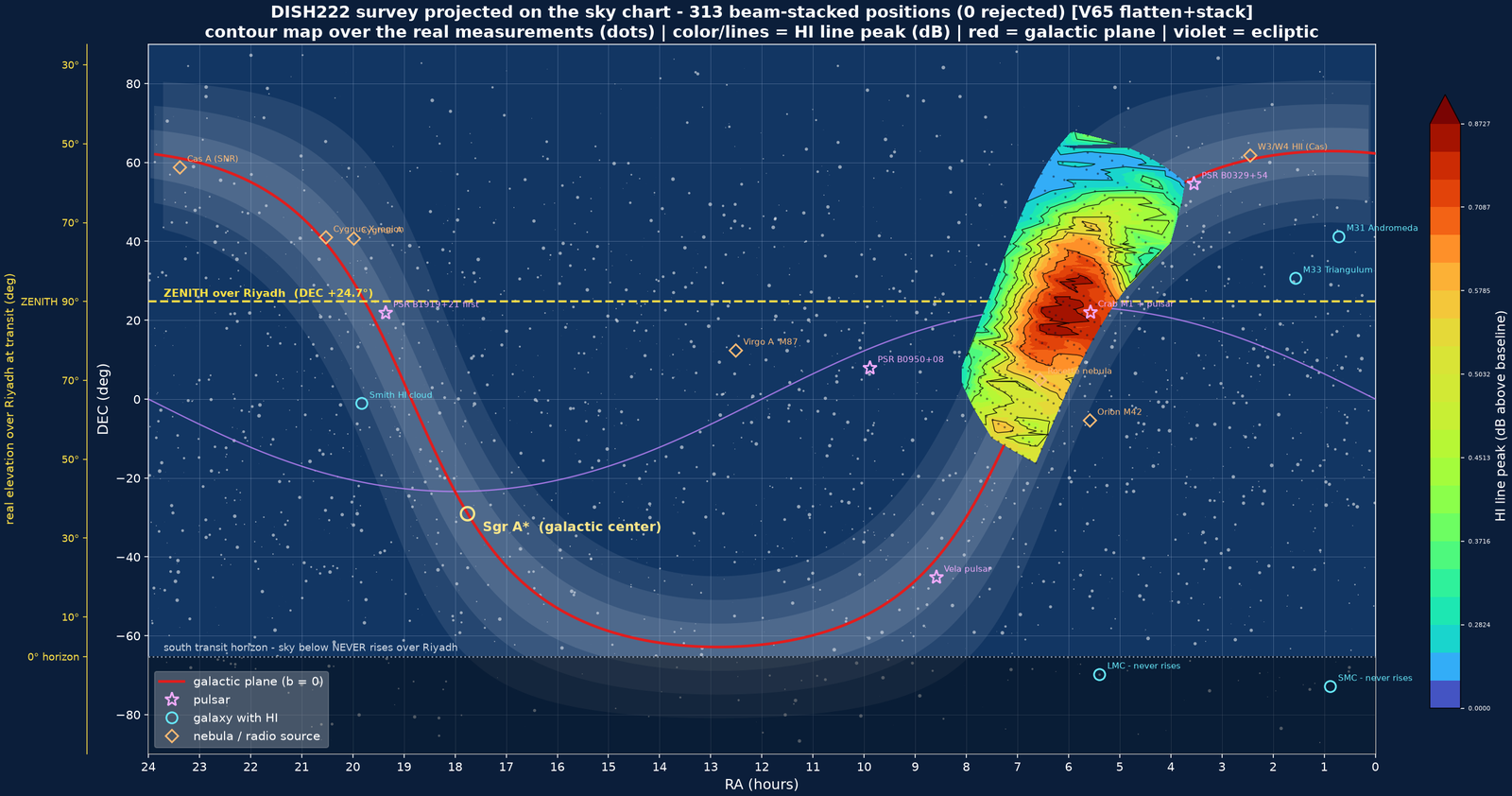
Sky chart with the Galactic plane as a red curve and a contour map of H I line strength covering the outer-Galaxy region scanned by DISH222 on 26 Aug 2026.
DISH222 raster of the outer Galaxy, 26 Aug 2026: 313 positions, H I line peak in dB above baseline (relative scale). The recommended starting dataset.
5 msteerable dish, DISH222, the active research telescope
1420.4 MHzthe H I 21-cm line of neutral hydrogen
L0 → L8every dataset tagged with its processing level and calibration scale
2025published IEEE Antennas and Propagation Magazine article

Where it started

The published fixed transit telescope

Before the steerable dishes, the project designed and replicated a fixed, zenith-pointing educational telescope, reported in the 2025 IEEE paper.

Published implementation reported in the 2025 IEEE paper

Reflector
5 m parabolic reflector with approximately f/D = 0.35.
Feed
Choke-horn/feed and low-noise receiving chain.
Performance
Approximately 35 dBi gain and approximately 2.5° beamwidth.
Method
Fixed zenith transit-scan observations using Earth rotation.

Today

The steerable telescope DISH222 is now the project's active research instrument. The fixed network and the first steerable dish, DISH1, are part of the project's history.

Compare the telescopes · Project story · Publication

Engineering to Science

From radio emission to Milky Way structure

Radio emissionReceived signalAveraged spectrumBaseline & RFI H I measurementCalibrationSky position + velocityMilky Way science

The conceptual endpoint is the H I brightness-temperature data product (\(T_B(\alpha,\delta,v_{\mathrm{LSR}})\)), connecting signal processing to sky coordinates and velocity.

α
Right Ascension
δ
Declination
vLSR
Radial velocity relative to the Local Standard of Rest
TB
H I brightness temperature

Follow the full chain for DISH222 data · Explore this in the lecture