Start Here · Student research portal

Join a working radio astronomy project

We map neutral hydrogen in the Milky Way with a 5 m steerable radio telescope, DISH222, at Prince Sultan University in Riyadh. This portal shows you the instrument, the real data, how the data become science, and the open questions you can work on.

What we observe

Cold neutral hydrogen gas emits a faint radio line at 1420.40575 MHz (wavelength about 21 cm). It passes through the dust that hides much of the Galaxy from optical telescopes. Its Doppler shift tells us how fast the gas moves towards or away from us, which is how the Milky Way's spiral structure and rotation can be traced.
With which telescope

The project grew from a network of fixed, zenith-pointing telescopes to steerable dishes. DISH222 is the active research telescope: a 5 m dish on an azimuth/elevation mount with a software-defined radio receiver. The earlier systems are part of the project's history.

Meet the telescopes

What kind of data exist

The telescope records averaged power spectra (not raw radio samples). Each dataset in the library is tagged with a processing level from L0 (native spectra) to L8 (independently reproduced result) and with the calibration scale it was made on.

Browse the Data Library

Where the project stands

What has been shown, and what is still open

A research project is never finished. This is an honest summary as of late September 2026.

Demonstrated

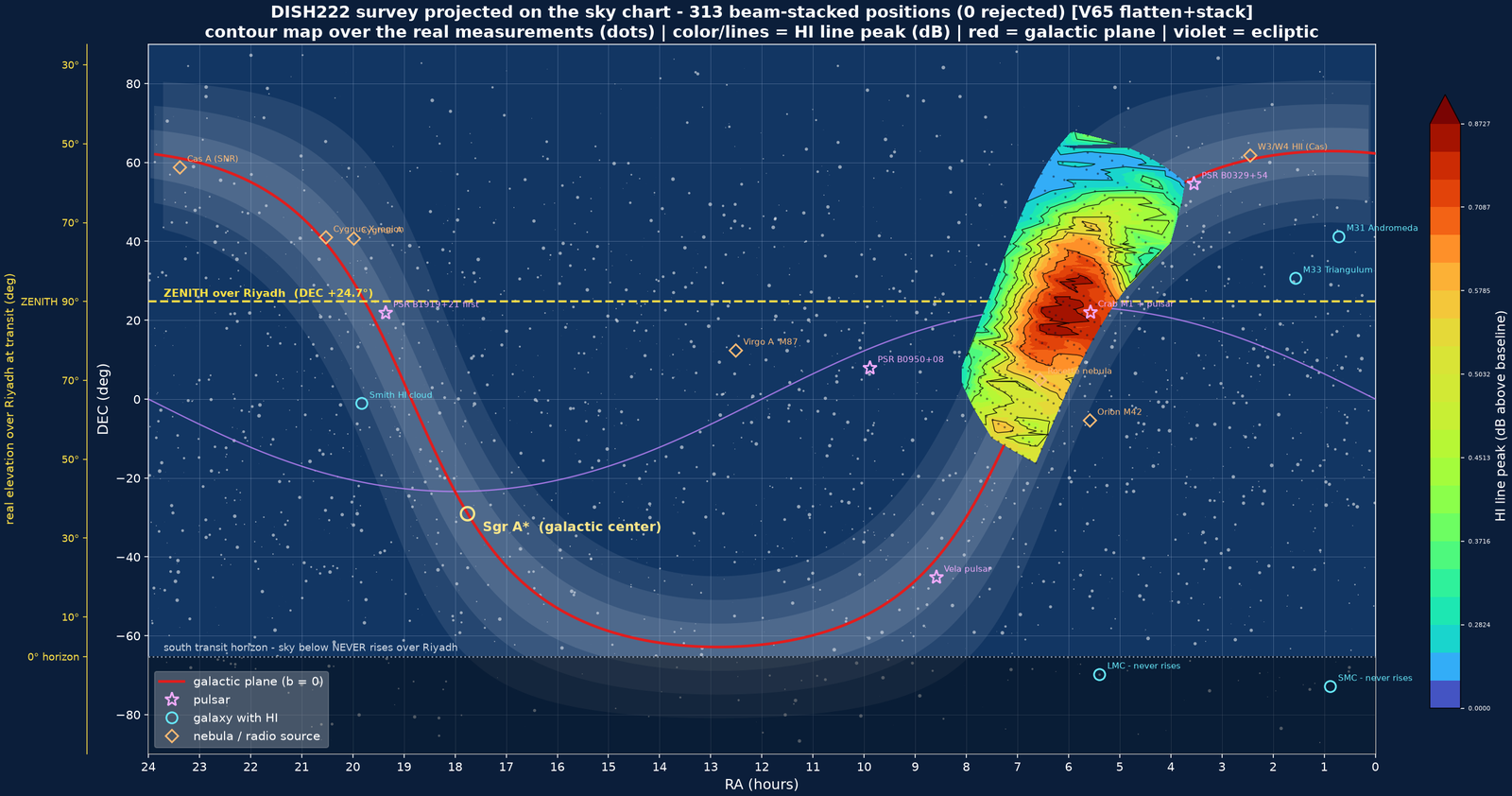
  • Automated raster scanning of the Galactic plane: the 26 Aug 2026 session visited 313 sky positions and recorded 776 averaged spectra.
  • H I brightness and velocity maps of the outer Galaxy, first on a relative (dB) scale.
  • Pointing improved from several degrees of error to about 1° after a Sun-based pointing calibration.
  • A kelvin temperature scale that went through five documented stages; the current one (C4) reproduces the LAB survey at eight reference positions with about 8.5 K scatter.

Still open

  • No complete observational product has yet been independently reproduced end-to-end, from native spectra to a final science product (nothing at level L8). Individual calibration calculations, such as the C4 eight-point fit, have been checked independently.
  • The current calibration (C4) has not been applied to any archived map; existing products stay on their original, historical scales.
  • The receiver noise temperature (about 860 K) limits sensitivity, and a small baseline pedestal is corrected only approximately.
  • Native spectra behind the September products and the all-sky composite are not yet in the research archive.
Recommended starting dataset

26 Aug 2026 · outer-Galaxy raster

A three-hour automated raster across Galactic longitudes 146°–226°. It is the strongest reproducible chain in the archive: the native averaged spectra and the pointing manifest are both available, together with every derived product up to maps and a spectral cube.

Its products are on the relative C0 (dB) scale. That is expected for this date and is part of what you will learn.

See the full chain

Sky chart in right ascension and declination with the Galactic plane drawn as a red curve; a contour map of H I line peak in dB covers the outer-Galaxy region near RA 4–8 h scanned on 26 Aug 2026.
26 Aug 2026 raster on the sky. 313 beam-stacked positions, H I line peak in dB above baseline (C0, relative scale). Produced by the legacy stitcher on the day of observation.

Lecture and portal work together

The 52-slide interactive lecture teaches the principles: the 21-cm line, Einstein coefficients, hot–cold calibration, baselines, LSR velocity, moment maps and data cubes. This portal shows how those principles are applied, with all their complications, to DISH222's real data.

Good companions: lecture slides 21–32 (physics), 33–43 (observation and calibration) and 44–51 (maps and cubes).

How to read this portal

  • C4 · current reference marks the adopted calibration scale.
  • C2 · historical scale marks products kept on the scale they were made with.
  • Values marked inferred come from analysis rather than a direct statement in a source.
  • Unknown details are listed as open questions rather than guessed.