Radio Astronomy Project Overview

Observing the Milky Way through the H I 21-cm Line

An educational and research radio astronomy platform combining a 5 m parabolic reflector, software-defined radio, signal processing, calibration, sky observations, and Galactic hydrogen-line analysis.

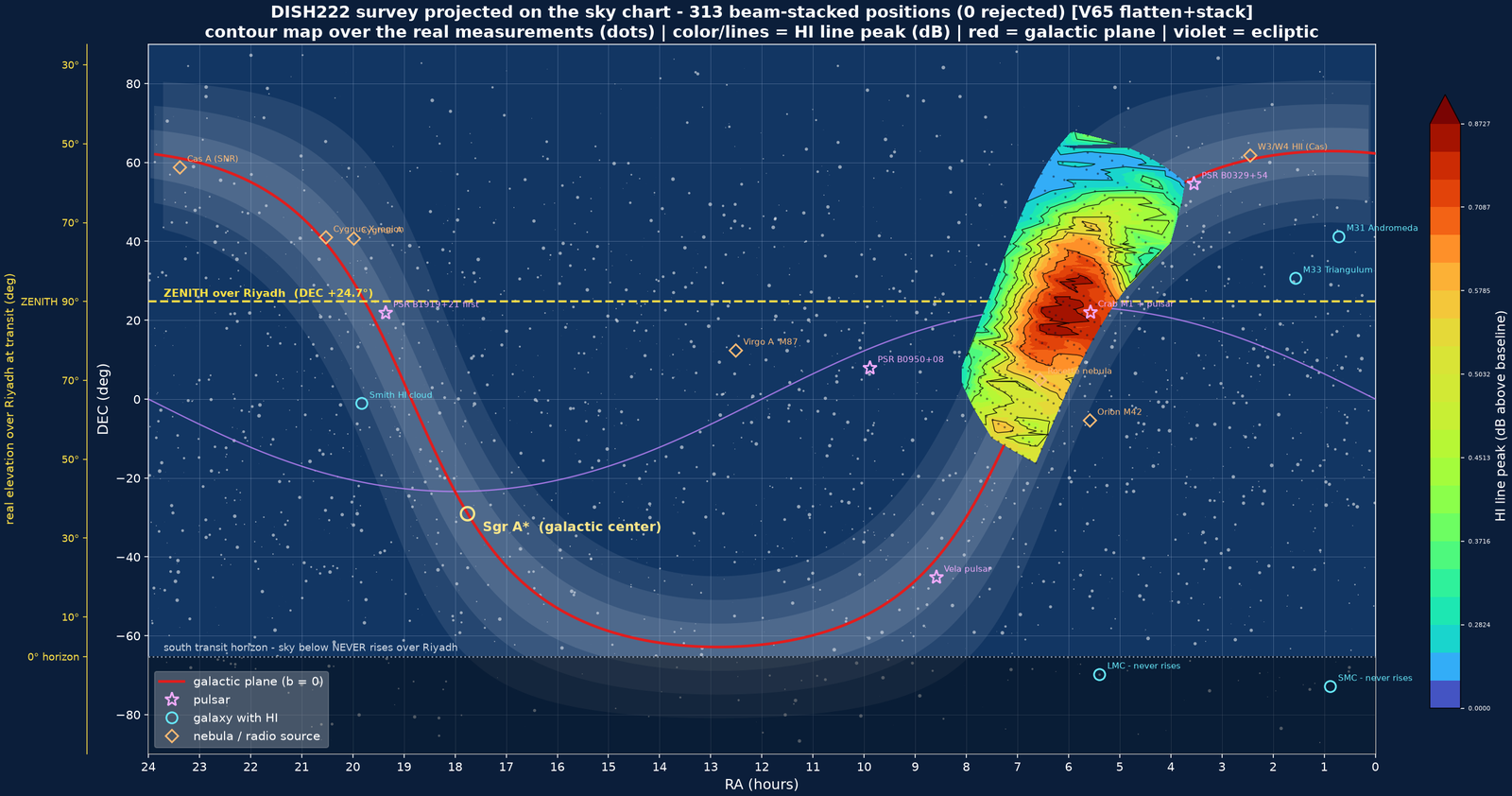
Project calibration and first survey result slide from the radio astronomy lecture
Project-generated lecture material: calibration and first survey results.
5 mparabolic reflector used in the educational telescope platform
1.42 GHzhydrogen-line observing band around the H I 21-cm transition
SDRsoftware-defined receiver chain for acquisition and spectral processing
2025published IEEE Antennas and Propagation Magazine article

Telescope System

An integrated radio astronomy platform

This overview summarizes the project at a glance: what it is, how the engineering platform works, what scientific observations it supports, how the system evolved, and where to continue into the full lecture, data, software, publication, and Arabic resources.

Published implementation reported in the 2025 IEEE paper

Reflector
5 m parabolic reflector with approximately f/D = 0.35.
Feed
Choke-horn/feed and low-noise receiving chain.
Performance
Approximately 35 dBi gain and approximately 2.5° beamwidth.
Method
Fixed zenith transit-scan observations using Earth rotation.

Current project status

Later project material also documents moving-telescope development, integrated control, calibration, survey work, and a growing educational portal. These later states extend the published fixed-system work rather than contradicting it.

Explore the full development story

Engineering to Science

From radio emission to Milky Way structure

Radio emissionReceived signalDigital spectrumCalibration H I measurementSky position + velocityMilky Way scienceEducational insight

The conceptual endpoint is the H I brightness-temperature data product (\(T_B(\alpha,\delta,v_{\mathrm{LSR}})\)), connecting signal processing to sky coordinates and velocity.

α
Right Ascension
δ
Declination
vLSR
Radial velocity relative to the Local Standard of Rest
TB
H I brightness temperature

Explore this in the full lecture